The Reed family of Fallbrook were early pioneers of Oregon and California. They were well known in Fallbrook and throughout the young State.
At the age of 12, in an ox pulled covered wagon, Martha Williams Reed came across the Oregon Trail, in 1841. Her parents and siblings are recognized as some of the first settlers of the Willamette Valley in Oregon. In 1849, gold fever caused Martha and her husband Jacob Reed to go south and witness the 1849 gold rush. Martha’s eleven children were born in various counties of California as the family migrated southward before settling in Fallbrook in the 1890s.
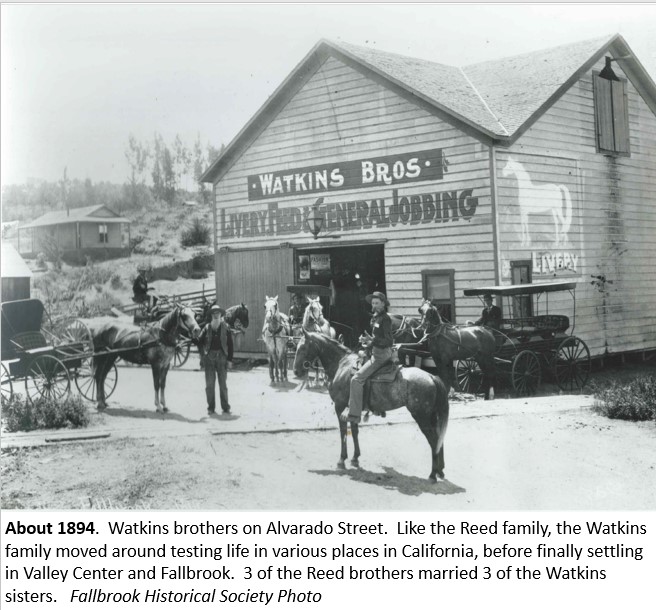
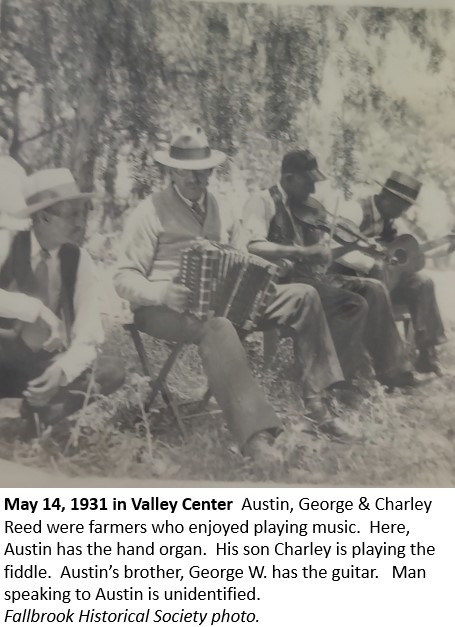
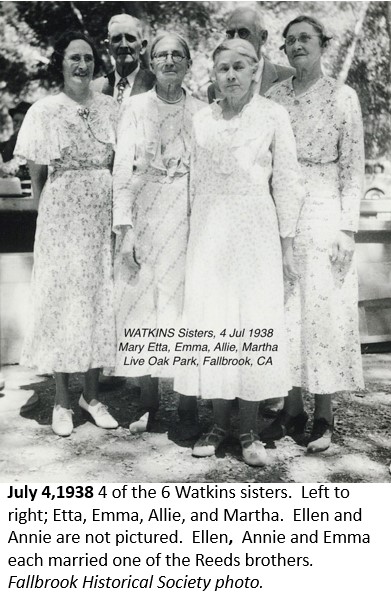
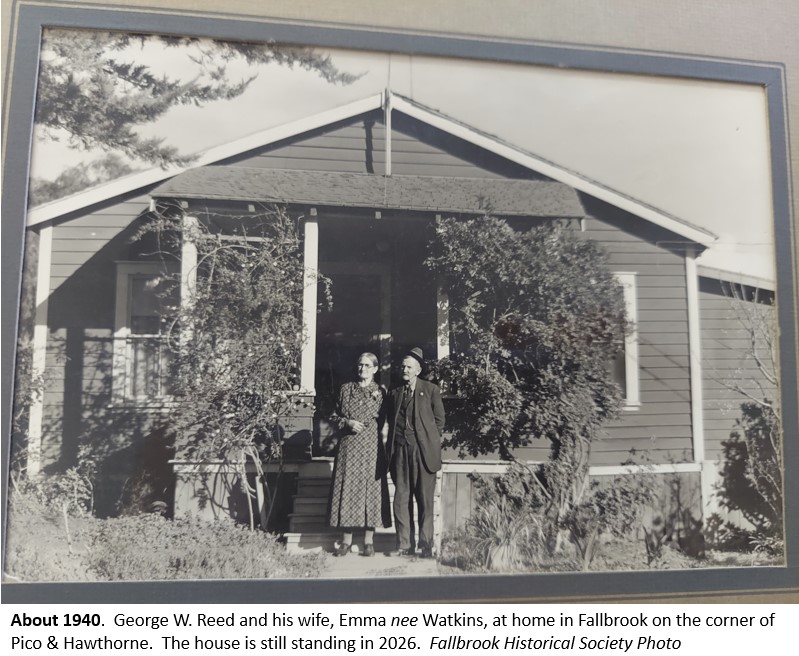
Her sons George Washington Reed and his brother Austin were farmers, but they enjoyed playing music. The Reed family and the Watkins family of the famous Fallbrook livery stable were well acquainted. Three of the Reed brothers married three of the Watkins sisters. George Reed and Emily Watkins Reed’s home is still standing in the center of Fallbrook.
Memoir of Mrs. Martha Williams Reed,
84-year-old resident of Fallbrook
as told to the Fallbrook Enterprise in September, 1913
Her memoir is repeated here exactly as she told it to the Enterprise;
I was born in Missouri June 9th, 1829 and was a family of nine children of Richard and Libby Huckaby Williams. In the Spring of 1841, my father with his family joined a company coming to California by ox-team. There were six of us children. My two oldest brothers, being married, remained in Missouri until two years later.
I was 12 years old in June. There were in our company two other families; Ben Kelsey with his wife and one child, his brother Sam Kelsey and two children, Andy Kelsey a brother, also Betsy Gray, a sister of Ben’s wife and her child; Zade Kelsey who was no relation to the other Kelseys, a preacher named Williams, John Bidwell who afterwards became Governor of California and several other men.
We started from near Osceola, Missouri. When we got to Independence, several other men joined our company, among them some priests who were going to the Flathead Indian Reservation. The first river of any note I remember was the Platte, and at this point my sister Winnie was married to Zade Kelsey, a young man in our company. After crossing the Platte, we were in buffalo region and saw thousands and thousands of buffalo and we had fresh meat all the way across the plains.
The first fort I remember was Fort Laramie. At this point a man named Cochran joined our company and afterwards married Betsy Gray. He persuaded father to go to Oregon. He said father would never get through to California with his family. At Independence Rock, one of the men taking his gun out of the wagon accidently shot and killed himself. We had to bury him without a coffin.
When on the Green River, mother and sister were both sick. I had to do the cooking and take care of my baby sister. There wasn’t much to cook as we were very short of rations. There was a man in the company who had provisions to sell, and my father hadn’t much money, so we couldn’t afford to buy much. As a result, we went hungry a good deal of the time.
The next place of note was Fort Boise, and the next Bear Valley, and Soda Springs. There the company divided. The priests for the Flathead Indians Cochran and his wife started back to Missouri on horseback. We heard afterwards their little girl died three days before they got there and they carried the dead body three days. Ben Kelsey and his wife and child and several others came on to California. They had many hardships, got out of food and had to kill their oxen and eat them, and leave their wagons and come on foot all the way; they all but starved. Mary Kelsey was the first white woman to come across the plains to California. They moved to Oregon and then to Texas where they had a girl scalped by Indians.
We had no trouble with the Indians. I remember one time the Indians caught one of our company away from the train, took his coat and hat and them followed him into camp. The captain of our company got them all off to themselves. The emigrants gave them their supper and they gave us no trouble. This was before they got to molesting the settlers.
From there we went to Fort Hall, about a day’s travel. There we traded our oxen and wagons for horses. We rode half of them and had packs on the others. Armentenger of the Hudson Bay Company piloted us on to Dr. Witmans. There we got some wheat and ground it in a hand mill, and I think some pickled pork. They had some tomatoes, but we didn’t eat tomatoes then. Dr Whitman and his wife had been there with the Indians for several years and had them civilized. We could hear them say their prayers at night and morning and evening. They learned some of them to do all kinds of work the same as white people. A few years after we went through there, some emigrants came through who had the measles and the Indians caught it from them. They thought Dr. Whitman had brought it there to kill them off, so the killed Dr. Whitman, his wife, and all that were at the station.
When we left Dr. Whitmans, he secured an Indian to pilot us down to the Dalles. We passed Walla Walla where we got some coarse flour. The only kind of guns we had were the old flintlocks. When we left the Dalles, another Indian piloted us on to Willamette Falls, what is now Oregon City. There was a missionary living there then and father went to him to get some flour, but he couldn’t let us have any until the board of provisions met. The next day they received some potatoes from a boat to care for the workers and we obtained some and really enjoyed the potatoes. That same day an old man came down the river in a canoe. His name was Moore. He told father to put his family in the canoe and take them across to the other side and we could share what he had, and we did. They also brought over our outfit in the canoe, and some Indians swam the horses across. The next day my father and my brother-in-law, Zade Kelsa, went out and took up government land clear to where the town of Hillsdale now is about 25 miles from Portland, but there was no Portland then. They built log houses and split shakes to cover them. The only white people there were Mr. and Mrs. Griffin, missionaries, and some men with Indian wives.
Father went to Vancouver to the Hudson Bay Company and they agreed to furnish his provisions until he could raise wheat to pay for them. We lived on boiled wheat lots of the time. The stones for the grist mill were brought across the plains by wagon.
I was the first white girl to cross the plains to Oregon. I never went to school any when I was growing up, because father never lived close enough to a school when I was growing up. The first fruit tree my father raised, he got cuttings and put the ends in potatoes and set them out.
In 1843, two years after we came to Oregon, my two oldest brothers who had remained in Missouri, came out with their families and with them a young man Jacob Thomas Reed to whom I was married September 5th, 1844. Each man and wife could take one half section of land, so we took a section all in one place and built a log house.
In 1849 when the gold fever sprung up in California, we rented our place and came by ox team to California. We then had two children; Samantha two years old and Joseph T, about one month old. Samantha died in August of that year at Sonoma, California. We remained in California over a year and then returned to Oregon.
When we came to Sonoma, Ben Kelsey and his family who came to California the year we went to Oregon. When we got there, his wife had gone to town on horseback to do some trading. While she was gone, an Indian who had lassoed a man and dragged him to death, tried to lasso her. When she got home, she told her husband and he came right over to our camp and wanted my husband to go with him to the Indian camp and said he was going to kill that Indian. My husband tried to persuade him not to go, without avail. When they got to the camp the indian was inside. Kelsey tried to get him to come out, but he wouldn’t. Kelsey threw a large rock into the camp which brought him out. Kelsey shot and killed him. Then Kelsey went into town and gave himself up, but nothing was ever done about it.
With John White and family, who came to California with us from Oregon, we kept a boarding house on the road to the mines. We were never molested by the Indians, but while we were there, they killed a Mr. Stone and Andy Kelsey, Jim’s brother from Clear Lake.
We went back to Oregon in 1850 and lived there until 1858, then came back to California and lived in San Roman, Contre Costa County. While in Oregon, three children were born; Sara Malinda in June 1851, Benjamin who died at the age of two years, Jacob T. Jr. March 4, 1857.
The next summer I got word that my father was very sick so went back to Oregon for a visit; went by water and was gone but a few months. In January, 1861 George W. was born. That summer we moved to Oregon again to sell our land. We stayed there three years before we could sell it; then we traded it for mules. We traded the mules for horses and brought them to San Roman and traded them for a ranch. While in Oregon we had a good deal of sickness; myself and all the children had the measles and some of the family had malaria. George W. the baby had a fever and nearly died. October 1863, Wilburn was born. I told my folks that I’d rather come back to California and live on bread and water, than live there and have plenty of sickness.
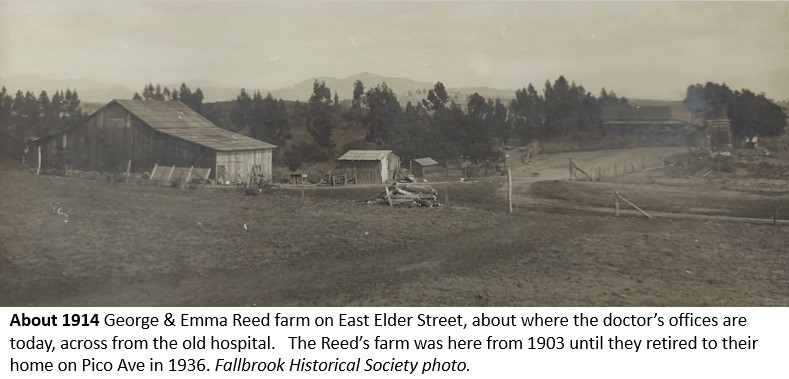
In 1864, we came back to California overland. One or two years later our land in Oregon sold for $10,000. In 1868 we sold our ranch in Contre Costa County and moved to San Luis Obispo. In Contre Costa County to more boys were born; Austin G. in 1865 and Granville F. in 1867. Most of the time we were sick with fever that year. In 1869 we took government land unsurveyed. In 1874, Emma my baby girl was born.
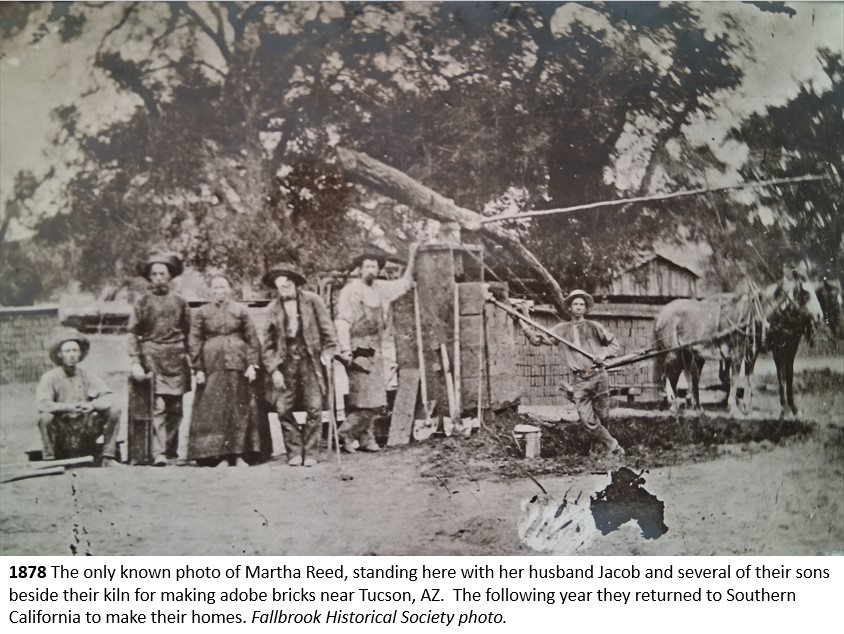
In 1877 we sold our place and started about July 1st for Arizona. We went with teams and traveled at night and laid by during the day while crossing the desert. That was a dry year and horse feed was very high. We didn’t live long in Arizona. We stayed there until Spring and came back to California. My husband and boys built a kiln to make adobe bricks that winter about 60 miles from Tucson. They got $20 per 1,000 bricks. Provisions were very high and the railroad only went to Yuma and everything had to be hauled from there. We came back to California in the Spring in 1878 and lived in Orange County near where Huntington Beach is now. In the Winter of 1880 we moved to Valley Center, San Diego County. There we took government land again. We lived in camp until Fall when the boys cut logs and built a house, the remnants which still stand. We had to go to 46 miles to San Diego to do our trading for the several years that we lived there.
My husband died in March 14, 1894 aged 69 years. I moved to Fallbrook, San Diego County, and lived with my oldest son Joe, where I still live.
I was well acquainted with the Weamer family that discovered the first gold and have seen the gold nugget which caused the great stampede to California in 1849. I was acquainted with Mr. Katty, one of the men that went to the rescue of the Donner party that was snowed-in in the mountains and where nearly all persons perished. Mr. Katty got his feet frozen and lost part of his toes. I am the mother of eleven children, eight of whom are still living. I have twenty-four grandchildren and twelve great grandchildren and will be 85 years old the 9th of June 1914.
Historical Society note:
Martha Williams Reed passed away January 7th, 1917 at the age of 87. She is buried in Fallbrook’s Oddfellows cemetery alongside several of her sons; Joe, George, Austin, and John and their wives.
The Fallbrook Historical Society has documented the genealogy of the Reed and Watkins families.
Tom Frew,
FHS Historian